
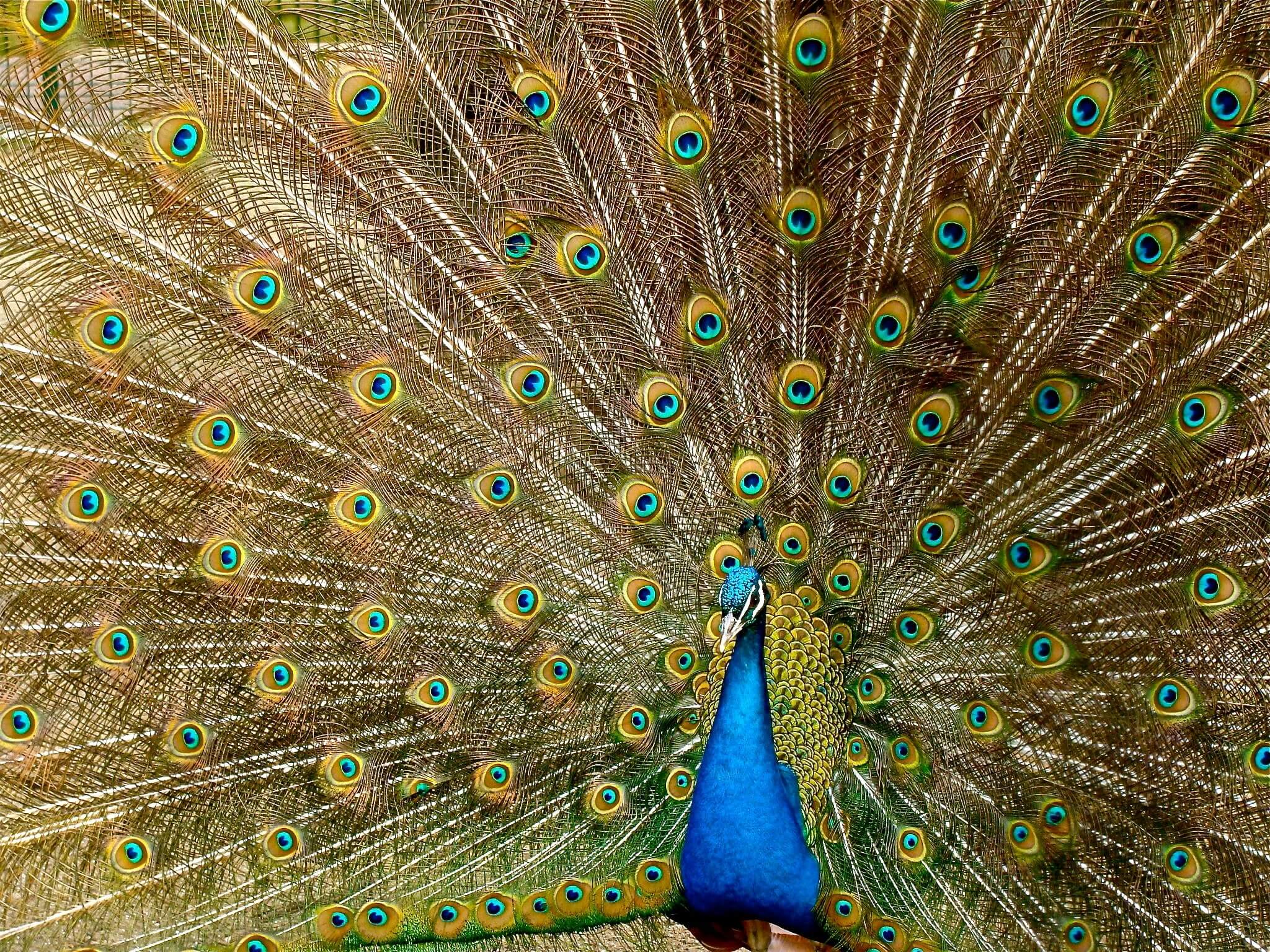
Peacocks are known for their elegant plumage, using their colorful feathered tails to attract a mate. While the term peacock is used colloquially to describe both male and female peacocks, it is not scientifically accurate!
A peacock is a type of peafowl, referring specifically to male peafowl. So, there technically is no such thing as a female peacock, as all peacocks are male peafowl!
The correct term for a female peafowl is a peahen.
Let’s take a closer look at these beautiful birds to find out more about the key differences between male and female peafowl!
Peafowl Colors
One of the easiest ways to tell the difference between male and female peafowl is the color of their plumage.
For example, it is only peacocks (i.e., male peafowl) that have vibrant colored feathers on their tails. These feathers come in an array of eye-catching colors and patterns, including bright blues and greens.
The reason peacock plumage is so colorful is to impress peahens during mating season. Peacocks open their tails to produce a vibrant display of colorful feathers, which match the similarly blue-green tones of their belly.
Female peafowl doesn’t have the same colorful feathers like a peacock. Their feathers are far less vibrant, featuring more subtle tones that aren’t always green or blue. In fact, many peahens have brown- or grey-colored feathers, allowing them to better blend into their natural environment.
Furthermore, a peahen also lacks a colorful belly, instead of having a plain white belly.
So, if you’re looking for a quick way to tell the difference between male and female peafowl, the color of their feathers is a big giveaway!
Peafowl Sizes
Another simple way to tell the difference between male and female peafowl is their size. Like with many animals, male peafowls are larger than female peafowls.
For example, an adult peacock typically weighs around 9-13lbs. In contrast, peahens are much smaller, weighing between 6-9lbs.
Also, a peacock has a much longer body, usually measuring around one foot longer than a peahen.
As you might expect, a peacock’s extravagant tail adds to its larger size. For instance, a peacock tail reaches up to 75 inches long! A peahen’s tail is a lot shorter than a peacock, only growing to about 3-6 inches long.
The reason that a peahen’s tail is much shorter is quite simple – they aren’t using it to attract a mate! Furthermore, peahen tails don’t fan outwards like peacock tails, which are used for mating and defending against predators.
So, if you’re unsure about the differences between a male and female peafowl, their body and tail sizes are another good hint!
Peafowl Necks and Facial Appearances
Not only are peacocks larger than peahens, but they also have more distinct heads and necks.
For example, a peacock’s long and slender neck is adorned with vibrant blue feathers with a soft, fur-like texture.
A peahen’s neck is around the same size as a peacock but has more bluish-green feathers. These feathers have a rougher texture though, making them appear more like scales than soft fur.
Additionally, peahens can ruffle their bluish-green neck feathers, whereas peacocks can’t ruffle their feathers.
Another notable difference is their facial appearance, most notably the markings around their eyes. While both genders of peafowl have distinct white markings around their eyes, there are some subtle differences.
For instance, the markings around a female peafowl’s eyes are closer in color to their skin. Because of this, their white markings blend more naturally with the rest of their body, making them visibility distinct as a peacock.
A peacock has the same white markings around its eyes, but this contrasts more noticeably with its vivid body color. Males have blue-green tones to their bodies, making the white eye markings stand out more compared to peahens.
Peafowl Crests
Both male and female peafowl have a crest of feathers on their heads.
These crests protrude from the peafowl’s head and are topped with a small group of feathers. Yet there are some differences between each gender’s crests.
For example, peacock crest feathers match the same vibrant colors as their tail and body, making them easier to spot during mating season. Peahen crests are a different tone, taking on the brownish-tan hue that matches their body.
Peafowl Behaviors
One of the key differences between male and female peafowl is how they act each day.
Males are constantly looking for impressive females, so spend most of their time fanning out their tails to show off their colorful plumage. Males are also more solitary, preferring to spend time alone rather than with other males.
Peahens don’t fan out their tails, instead of ruffling the feathers around their necks. They only tend to ruffle their neck feathers in certain situations, such as when fighting another peahen. Female peafowl often fight with each other for the best males during mating season.
Ruffling is also used to alert their fellow peafowl to dangers, such as nearby predators.
Also, peahens are not as solitary as peacocks. They maintain a strong maternal instinct, caring for peafowl chicks throughout the day. Females are also nest builders, creating a home for their chicks after mating with a peacock.
As they’re more social than peacocks, peahens don’t mind spending time with other peahens. However, they’re often territorial, especially during mating season, ruffling their feathers as a warning sign

Conclusion
So, if you’ve ever wondered if there is a female peacock, now you know the answer!
There are technically no female peacocks! Peacocks are a male peahen, with female peafowl known as peahens. If you’re ever unsure how to tell the difference between a peahen and peacock, there are many things to look for.
The most obvious difference between male and female peafowl is their colors. Only peacocks have large and colorful tails, which they fan out during the mating season to attract a peahen. Peacocks are much larger than peahens, so telling the difference between each gender should be easy enough for most.