
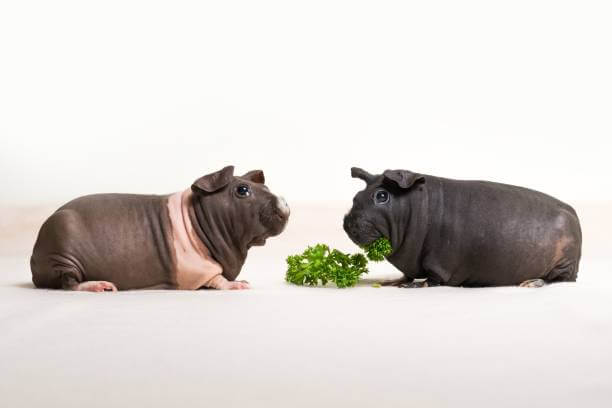
When it comes to owning pets, we have many options in the world. Today, many people choose to keep pets that might otherwise be seen as odd. For example, the guinea pig has commonly become a choice for those who want a rodent-like creature. They can be a good contrast to something like a rabbit. When kept properly and looked after, such a pet can be great for kids to spend time around. However, one thing you might think about is whether or not you want a typical guinea pig or a skinny pig. What is a skinny pig? Put simply, it is a hairless guinea pig.
Guinea pigs are typically covered in thick hair that has to be cleaned and dealt with on a regular basis. Otherwise, it can become thick, matted, and dirty. This can cause problems for their well-being. The hairless guinea pig, by contrast, has absolutely no fur. It actually looks more akin to a tiny baby rhino to some people!
Most of us think of guinea pigs and imagine their thick and charming coats. However, the hairless guinea pig is basically the exact same thing without the hairy nature. This makes them look insanely different to their hairy brothers and sisters. However, the ‘skinny pig’ is a pet type that has grown in popularity in recent years.
Thinking about owning a hairless guinea pig? Then use this simple guide to understand what you would be buying.
What is a hairless guinea pig?
As noted above, they are essentially guinea pigs without the hair. They are less common than a normal guinea pig, but many choose them over the haired equivalent due to maintenance. Without all of that hair and thus shedding to manage, your care times can be minimized and even reduced entirely. However, in terms of personality, there is not too much of a difference.
If you have kept a normal guinea pig, you would find it very easy to adapt to a hairless guinea pig.
One thing to note about hairless guinea pigs is that they are very easy to look after. If you have never had a pet before, or your child wants a pet, these are low maintenance, beginner-friendly types. They are very easy to look out for and to care for in general. This makes them great pets to go for if you want something a little bit different in terms of looks.
They are friendly and endearing little animals that tend to spend a lot of their time just milling around. In terms of diet, they eat fruits, vegetables, and hay. Most will also eat pellets – just like their haired cousins. These are highly social little creatures who can have lots of fun with other guinea pigs, but they are naturally wary of other species.
If you have something like a dog hanging around the place, the hairless guinea pig will usually try their best to stay out of their way as best they can.
Where did hairless guinea pigs come from?
This is something that tends to be shrouded in hearsay and confusion. The first real spotting of such a creature came in the late 1970s, usually timed at around 1978. They were believed to have been the cause of some form of genetic mutation in an otherwise normal guinea pig. Pet lovers soon picked p on these phenomenal creatures, and by the 1980s they were being bred en masse due to their hairless nature.
This makes them a lot easier to use in things like laboratories and dermatological studies. The lack of hair makes them easier to give treatments and see the actual results on their skin. Indeed, the hairless guinea pig has skin that is very similar to a human – this means that testing can feel logical as what works on a hairless guinea pig can typically work on a human.
In terms of their mindset and personality, though, the hairless guinea pig really does not differ very much at all from the haired equivalent.
What do hairless guinea pigs act like?
In terms of their personality traits, there are quite a few things to note about these little creatures. Typically, they share the same outgoing and social personality traits as normal guinea pigs. This means they need to be kept in groups, or even pairs (see below) to get the most out of their personality.
They love to be around other guinea pigs, but they will also love to spend time with you and your family. You might hear them talking away to one another in the garden, which can be quite cute to notice. As such, they tend to be quite placid and social little creatures.
One thing to note, though, is that they lack any kind of meaningful aggression. They do not really get aggressive with you, their owner, or other guinea pigs. If another pet turns up, though, like a dog, they might run for cover. They prefer to run away from other animals as opposed to standing their ground. Given their size and dainty nature, that makes a lot of sense!
Typically, the hairless guinea pig will enjoy being taken out of their cages and spending some time running around. Make sure that you and your family/children are quite careful with them, though; their delicate frames can be badly damaged if you are even a little bit too forceful when running around.
Are hairless guinea pigs entirely bald?
Interestingly, no!
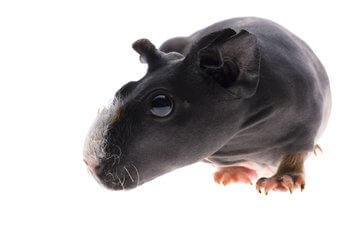
There are some hairless guinea pigs that are actually still carrying some form of hair. This is typically seen around their nose, their feet, or their back. Typically, though, they are going to have a vast majority of bare skin versus hair. Keep that in mind, as they tend to be something that looks a bit harrier than you would expect. So long as there is more skin than hair, though, they can probably be referred to as a hairless guinea pig as opposed to the haired equivalent.
That might seem odd, given the name, but the majority of these pets will be entirely hairless across their bodies.
Can I keep a hairless guinea pig as a pet? How much would it cost?
The good news is that yes you can keep a hairless guinea pig as a pet without any problems at all. They have become a common pet as many people like the lack of maintenance due to the hair issues being removed. Guinea pigs are hard to keep as pets at times due to their hair. This can make them feel uncomfortable and overly warm during the summer. However, the hairless guinea pig does not have that problem. As such, some who lack the time or effort to cut and manage their guinea pigs’ hair could start here.
If you wanted to own such a pet, you are probably looking at something in the region of $100 to $200 in cost. They are most commonly found in color schemes ranging from chocolate and cinnamon to silver and white. Gold is increasingly popular and common, too, surprisingly. If you find a hairless guinea pig that is of a unique color trait, though, you could definitely find that the price can balloon beyond even double of this amount. Try to keep that in mind, as the more unique the color the more likely it is that you will pay a little bit of a premium towards owning your new friend.
Should I have one hairless guinea pig? Do they live happily alone?
Not really, to be honest. The vast majority of hairless guinea pigs are going to be happier in at least a pairing. They are social and happy animals when they can spend time together. Put them into an isolationist household, though, and they can soon begin to show traits of sadness.
They need to have other hairless guinea pigs in their life, or even a normal guinea pig, to feel comfortable. This will ensure that they can grow to be the best animals they can be, all the while developing desired personality traits. If you keep a hairless guinea pig alone, they can become quite brooding and sad.
Housing a hairless guinea pig
The next thing you need to take into account is how you care for that guinea pig as time goes on. The first thing you need to do is look into their cage. a hairless guinea pig will usually need a tank with around 7.5ft of space. However, since they are not good solo pets, you likely need a bigger tank to handle more than one hairless guinea pig at one time.
Keep that in mind as you should be looking for a multi-story tank. This should give them a chance to move up and down the levels; as natural burrowers, they love to be able to move up and down. Flat ground is far less entertaining to them. By having a little ramp or something to go up, your skinny pig is likely to be in a much better mood.
Of course, if you keep them out of their enclosure, they can enjoy running around without needing that same level of horizontal space. Larger cages make sense because it means they can keep their toilet duties away from where they sleep and where they enjoy recreational activity. This is better for their health, and it should make cleaning out their tank a whole lot easier in the long run for you.
In terms of bedding, make sure you give your hairless guinea pig a separate bed and that it has plenty of lining. Substrate lining is the best choice as this can be dug into; if your skinny pig gets cold, they can dig into the lining for extra depth.
You might find that something like paper shaving works, but we recommend using something that is not made from pine or cedar. These are normally made using some form of chemical that, if eaten, could hurt your skinny pig.
Make sure you give your hairless guinea a temperature regulation in the 65-75F region. So, try and avoid putting them too close to things like heaters and fireplaces, or air vents. Avoid putting them in direct sunlight, too, when they are sleeping at least.
Feeding your skinny pig
The last thing to think about is what you will feed this particular breed of animal. They typically need to be given pellets made from hay, Timothy hay if you can. This is good because it can give them a good way to bulk up their bellies and stay full. Try and add in a mixture of fruit and veg, too.
A happy blend of things like tomatoes, asparagus, leafy greens, carrots, and fruits like pears, kiwis, and apples can work well. However, avoid giving your hairless guinea pig too much fruit as the high sugar content could see their weight explode. This can even lead to diabetes, which can be very hard to diagnose and deal with for your skinny pig.
Compared to your standard guinea pig, the hairless variety needs a higher metabolism. This keeps their energy levels balanced and their core temperature high. This is needed due to the lack of hair to keep them warm. So, make sure you feed them a bit more than you would a normal guinea pig.
The challenge is finding the right balance between feeding them enough and overfeeding. As ever, work with your local veterinarian to come up with a plan of action that will benefit your hairless guinea pig.
Summing up
There is much work involved in caring for and raising an animal like a skinny pig. However, if you have previously had a guinea pig, you should not find it too challenging. Small differences exist, yet, but the majority of your time with a hairless guinea pig should be serene and enjoyable.
If you want a pet that is different from a normal guinea pig, but no different to raise, start here. The skinny pig is an interesting creature – and for many people, it could be their ideal first pet.